
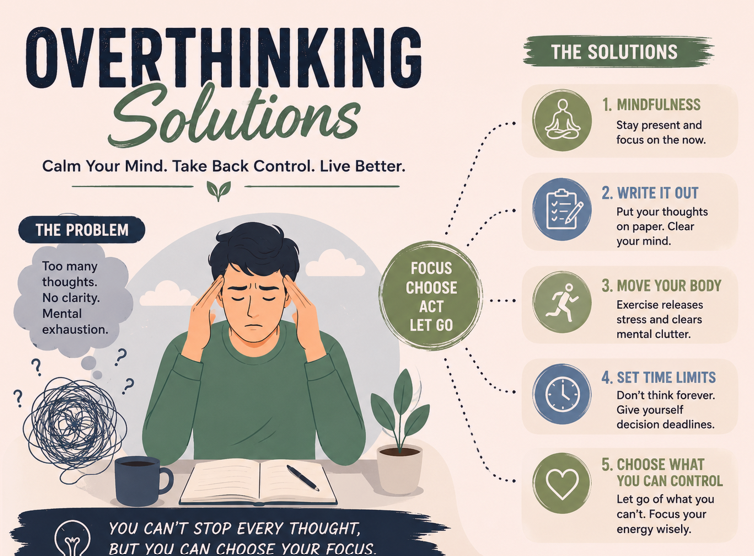
Overthinking is one of the biggest mental health struggles people deal with today, and I mean it pretty constantly. In the United States, millions of people keep replaying conversations, fretting about the future, and breaking down moments that don’t really need that much attention. In the end, overthinking tends to bring stress along with anxiety, low output, and emotional tiredness that lingers. Good news though, there are practical, effective overthinking solutions, that can calm your mind and boost mental clarity. When you learn how to manage those stuck, repeating ideas, you can lower stress, choose better options, and live with a more balanced daily rhythm.
In this guide, you’ll find out what actually triggers overthinking, how it hits mental health, and the best overthinking solutions that really work
What Is Overthinking?
Overthinking happens when you spend too much time analyzing problems, situations, or decisions. Instead of arriving at solutions, your mind gets caught in repetitive thinking loops. It feels like you’re “doing something”, but in reality, nothing moves forward.
For example, you might:
- Replay past mistakes again and again
- Worry about a future outcome, even when there’s nothing to do
- Scan for hidden meanings in ordinary events
- Re-check choices like you’re trying to find a perfect answer
- Worry too much about what comes later
- Overanalyze talks
- Fear of making the wrong choice
- Picture the worst-case scenes
Even if careful thinking can sometimes be handy, excessive thinking often causes unnecessary stress and confusion. So yeah, learning how to handle your thoughts is extremely crucial for mental well-being.
Why Overthinking seems So Common nowadays
Modern life puts people under steady pressure and keeps feeding them information overload. With social media, work stress, money worries, and digital distractions in the background, a lot of people cannot really relax in their minds.
Also, people in the USA are seeing:
- Higher stress levels
- More anxiety
- Social comparison on social media
- Information overload
- Fear of failure
So overthinking becomes very common with students, professionals, and teenagers all together. Plus, endless digital stimulation tends to make it harder for the brain to pause, recover, and reset.
Signs you are Overthinking way too much
Noticing the signals is usually the initial step when you want to start using better overthinking solutions.
- Ongoing Worrying
You keep turning possible problems over in your mind even when there is nothing actually wrong. Because of that, your brain can stay in a steady state of pressure, like it never powers down.
- Trouble Falling Asleep
When night arrives, overthinking often intensifies. Your mind refuses to soften, so you end up with restless sleep. Many people experience weak sleep quality and insomnia.
- Running The Scene Back
You repeatedly replay what you said or did during conversations. Often, this leads to needless self-doubt, and anxiety shows up anyway.
- Worry About Choosing
Even little selections can feel heavy, because you keep worrying about wrong moves. So, making decisions becomes mentally exhausting faster than it should.
- Mental Burnout
Excessive thinking can leave you feeling emotionally drained, plus physically worn out. Over time, that mental overload may start to weaken your overall sense of well-being.
What actually triggers overthinking?
Understanding the root cause helps you pick the most suitable overthinking solutions, even if your brain keeps trying to jump ahead.
- Anxiety and Stress
Anxiety often makes the brain keep scanning for possible threats or trouble. So, your mind might have a hard time feeling at ease and staying that way.
- Fear of Failure
Many people overthink because they are afraid to make mistakes or to end up disappointing other people. Because of this, they end up spending too long dissecting every choice.
- Perfectionism
Perfectionists tend to scrutinize every little detail, because they want it all to come out flawless. It can become a constant measuring process.
- Trauma or Negative Experiences
Previous events can make someone overly watchful and mentally vigilant. As a result, the brain may set up repeating thought loops, more or less for self-protection.
- Social Media Comparison
When you keep comparing your life to other people online, it can raise self-doubt and tilt your thoughts toward the negative. Also, unrealistic online benchmarks may weaken your self-confidence.
How Overthinking Affects Your Mental Health
Overthinking can throw a wrench into both your mental state and physical well-being; it really can.
- More Anxiety
The more you replay problems over and over, the more anxious you may start to feel. After a while that loop becomes emotionally too heavy, like you can’t breathe through it.
- Weaker Focus
Too much thinking messes with your ability to zero in on what matters. And then your productivity takes a hit, because you keep drifting away from the task.
- Sleep Trouble
At night your mind may refuse to unwind. So you might end up with insomnia, or at least sleep that feels light and unrefreshing.
- Less Work Done
When you overanalyze decisions, you often stall and delay action. In the end your output drops, and major goals end up taking longer to reach.
- Emotional Exhaustion
Ongoing mental strain can eventually drain your energy. You may feel emotionally spent, with low drive showing up more often.

Best Solutions for Overthinking (That Really Help)
The good news is, you can manage overthinking with everyday lifestyle adjustments and healthy mental routines. If you stick with these practices consistently, you can coach your mind to stay steadier, calmer, and better centered over time.
Practice Mindfulness
Mindfulness helps you stay focused on this moment, not getting stuck worrying about what already happened or what might happen later. And yeah, it sounds simple, but your mind still drifts, you just gently bring it back.
- Some everyday mindfulness habits include
- deep breathing exercises, meditation, journaling, and mindful walking
Also, doing mindfulness for just 10 minutes each day can lower mental stress in a noticeable way. Besides that, mindfulness supports emotional awareness and improves focus, too.
Stop Trying to Control Everything
One of the best overthinking remedies is learning how to tolerate uncertainty.
You cannot control every outcome in life, so trying to micromanage every possible scenario tends to add even more tension and anxiety.
- Instead you can
- lean into what you can control
- accept imperfections
- Release unrealistic expectations
When you shift to this mindset, emotional steadiness grows, and the mental burden feels lighter.
Overthinking Solutions: Limit Social Media Use
Social platforms often encourage comparison, anxiety, and repetitive negative thinking
Like, if you’re constantly seeing other people’s achievements, you might end up questioning your own progress. Consequently, this can crank up self-doubt and emotional stress, or just make everything feel heavier, for no real reason.
To reduce overthinking, you can try a few things like:
- Limit screen time.
- Take social media breaks periodically.
- Unfollow negative accounts, yes.
- Spend more time offline, with people or just with yourself.
Then your mind may feel calmer, lighter, less flooded, and not as overwhelmed.
Overthinking Solutions: Write Down Your Thoughts
Journaling is one of the simplest and more effective solutions to overthinking.
Writing your thoughts down helps with:
- Organizing your mind
- Reducing mental clutter
- Processing emotions
- Spotting irrational fears
Also, journaling can help you notice unhealthy thought patterns and swap them for healthier perspectives.
Overthinking Solutions: Focus on Action rather than Analysis
Overthinkers often spend too much time analyzing and not enough time doing something.
Instead of waiting for the perfect decision:
- Move in small steps forward
- Learn from mistakes
- Aim for progress instead of perfection
Action builds confidence over time. On the other hand, too much thinking can create fear, and then hesitation sometimes.
Create a Daily Routine That’s Actually Supportive
Having a well-paced routine can reduce mental noise, and it can make emotional stability steadier.
Healthy habits can include regular exercise, proper sleep, healthy eating, morning routines, and scheduled breaks. The thing is, consistency helps calm the mind, and it improves focus later. Also, a steady routine can lower stress levels throughout the day.
Overthinking Solutions: Confront Negative Thoughts
Not every thought is accurate. So, it matters to examine the negative thinking patterns.
When negative thoughts show up, try asking yourself:
- Is this fear realistic?
- Am I assuming the worst, automatically?
- What evidence backs up this thought?
When you question these irrational ideas, you reduce anxiety and gain clearer mental focus.
Overthinking Solutions: Prevent Catastrophic Thinking
Overthinkers often picture the worst outcomes, before anything even happens.
- For example, “What if I fail?” or “What if everyone judges me?”
- “What if something goes wrong”
Instead of jumping straight into disaster mode, try leaning into realistic possibilities. Most times, your worries feel far more intense than what actually happens in the real world.
Overthinking Solutions: Exercise Regularly
Physical activity is one of the most powerful natural responses to persistent overthinking.
Moving your body can help with:
- Lower stress hormones
- Lift your mood
- Sharpen attention
- Increase mental energy
Even a basic 30-minute walk can steady an anxious mind. Also, staying consistent with movement supports both mental well-being and physical health.
Overthinking Solutions: Talk to Someone You Trust
Sometimes, saying your thoughts out loud to another person gives you a clearer view and a little emotional breathing space.
Talking with :
- Friends
- Family members
- Therapists
- Mentors
can help you build a healthier perspective. Plus, emotional support frequently reduces stress feelings and that annoying sense of isolation.
Daily Habits to Reduce Overthinking
Here are a few everyday routines that help your mind feel calmer:
- Begin the morning without checking your phone
- Practice gratitude each day
- Get time outside
- Avoid multitasking
- Read books, not endless scrolling
- Listen to calm music, not constant noise
- Make sure you get enough sleep, like actually enough
These tiny routines can feel a bit small, but over time, they often lead to real improvements
How long does it take to stop overthinking?
Overthinking is a habit, and habits take a while to shift
Some people feel better in a few weeks, others might need more time. Still, the point is steady practice and patience
When you regularly use healthy coping tactics, your mind gradually learns to respond to stress and uncertainty in a different way
When should you get professional help?
Sometimes, overthinking gets tied to anxiety problems or long-term stress
- It may be time to talk to a professional if
- Overthinking interferes with your everyday life
- You get panic attacks
- Anxiety starts feeling too heavy to manage
- Sleep troubles keep going for weeks or months
In these cases, therapists and other mental health specialists can offer practical support and proven coping techniques
Final thoughts
Overthinking can feel exhausting, frustrating, and emotionally overwhelming, like your head is always running on a loop, even when you want it to stop. Still, with the right strategies, it is possible to quiet your brain down and slowly regain control over what you think about.
Most of the best solutions for overthinking usually come from small changes that you repeat consistently. If you practice mindfulness, cut down digital distractions, question gloomy thoughts, and shift attention toward action, your mental focus and emotional steadiness tend to improve over time.
Also, your mind does not have to wrestle with every possible problem all at once. Instead, sometimes the best choice is to pause, breathe deeply, and return to the here and now.
With patience, daily practice, and supportive habits, you can step away from overthinking and build a calmer, more balanced life.